
Want to make a still photo move without paying for software or creating yet another account? What once required editing skills can now take less than three minutes. This guide explains what photo to video AI free actually means, how to choose a useful free option, and the exact workflow for turning a photo into a short video online.
FreeImage2Video is built for that quick first result: upload a photo, optionally describe the motion, generate a five-second guest clip, and download the MP4. A guest can complete one lifetime 480p generation without an account. Creating a free account adds 12 one-time credits—enough for one standard 480p, five-second generation—and unlocks 480p, 720p, or 1080p settings from 1 to 15 seconds. Those signup credits do not refresh or expire.
Looking for a direct, tool-first workflow? Try our picture to video AI tool to upload a picture and generate a video on the same page.
Turn a photo into a video now
Try the free photo-to-video AI tool — no sign-up required →
One lifetime guest generation. No credit card. Free output is 480p with a watermark.
What does “photo to video AI free” really mean?
Photo-to-video AI analyzes a still image and predicts how its subject, background, lighting, and camera could move across a short sequence of frames. Instead of manually building keyframes, you provide the starting photo and, if you want more control, a short motion prompt.
“Free” does not always mean the same thing. Video generation uses paid GPU processing, so most tools limit free usage in one of three ways:
| Free access type | What you usually get |
|---|---|
| No-login free | Generate immediately, with a strict daily allowance |
| Account-gated free | Create an account for renewable daily or monthly credits |
| Trial credits | Receive a one-time credit balance that does not renew |
If you need one or two quick clips and want to avoid an account, a no-login generator is the most direct fit. If you generate frequently, an account-based option with renewable credits may offer a larger allowance.
How to turn a photo into a video with AI for free
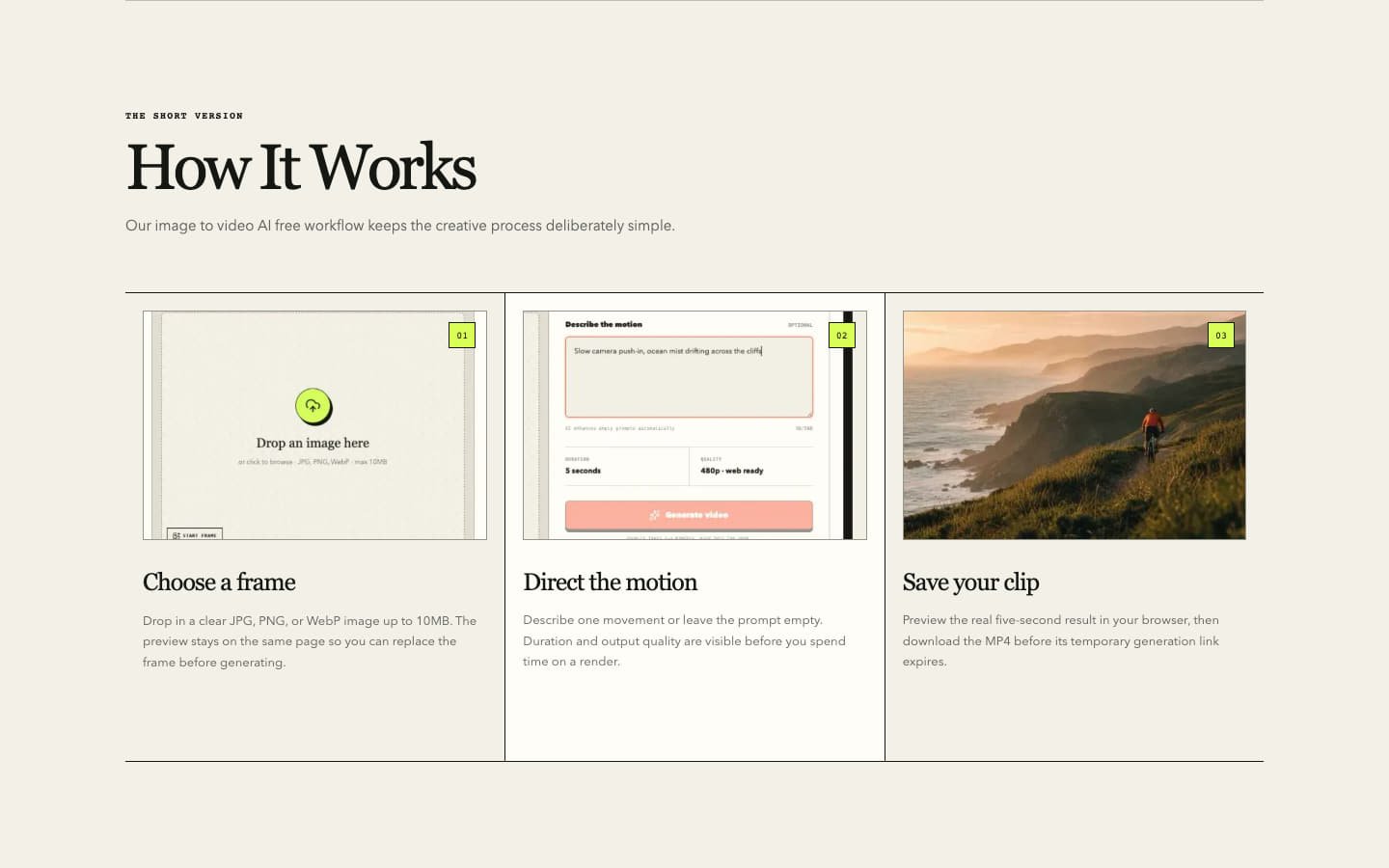
The fastest workflow takes three steps: upload, direct the motion, and download the finished clip.
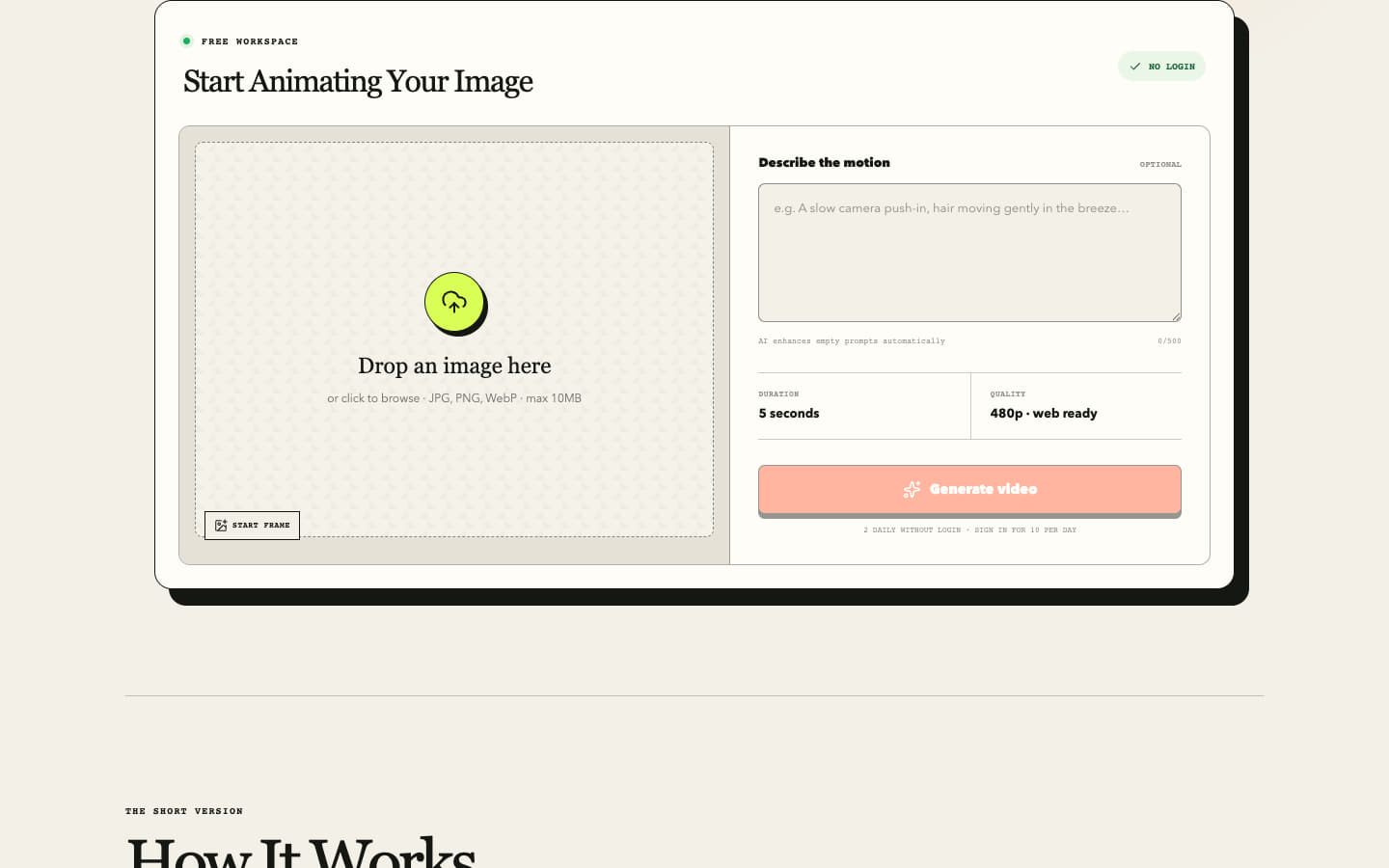
Step 1: Upload your photo
Open the free photo-to-video generator, then drag your image into the upload area or choose it from your device. The current tool accepts JPG, PNG, and WebP files up to 10 MB.
For a stronger first result, choose an image with:
- one clear subject;
- visible separation between the subject and background;
- sharp, well-lit details;
- enough room for the requested movement;
- little or no small text that must remain perfectly stable.
Crowded scenes, overlapping hands, heavy compression, and tiny lettering give the model more uncertain details to reconstruct between frames.
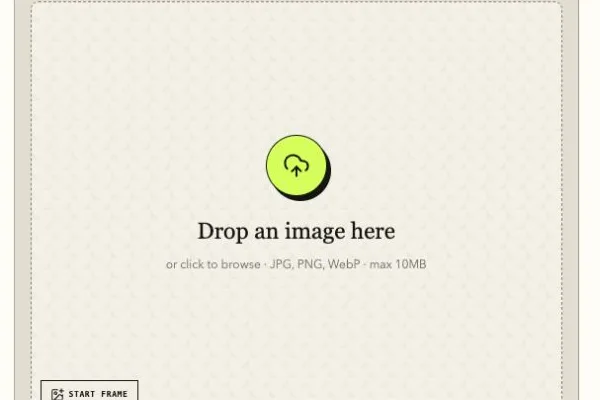
Step 2: Describe the motion—or leave the prompt empty
The motion prompt is optional. You can write a focused instruction such as “slow camera push-in, hair moving gently in the breeze,” or leave the field empty and let the tool enhance the prompt from the image.
Useful motion prompts describe one subject action and one camera movement:
| Photo type | Motion prompt to try |
|---|---|
| Portrait | Gentle blink and head movement, soft light, slow camera push-in |
| Landscape | Clouds drifting, water moving naturally, slow pan across the scene |
| Product photo | Subtle rotation, light reflection sweep, steady camera |
| Pet photo | Ears twitch, natural breathing, tail moving gently |
Short, physically plausible instructions usually preserve the source photo better than requests for several dramatic actions at once.
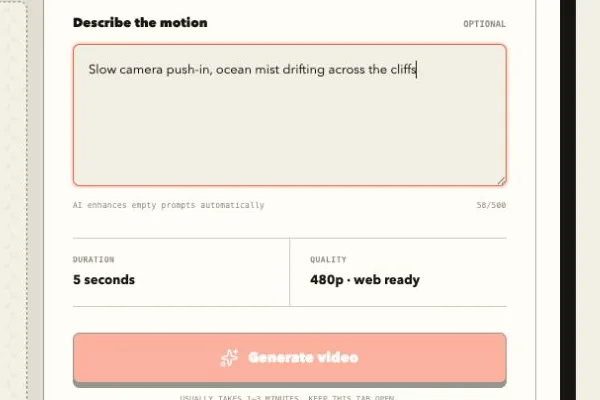
Step 3: Generate, preview, and download
Select Generate video and keep the page open while the AI processes the image. Most generations complete in one to three minutes, although queue time can change with demand.
The guest trial creates a five-second 480p video. Signed-in users can choose 480p, 720p, or 1080p and a duration from 1 to 15 seconds, subject to their credit balance. Guest and free-account output includes a FreeImage2Video watermark; active Pro and Max subscriptions generate without it. When the preview appears, play the complete result and check whether the subject stays recognizable, the motion follows your prompt, and important details remain stable. Then select Download video to save the MP4.
Completed videos are normally copied to managed media storage, but you should download a local copy of any result you need to retain.
Ready to animate your photo?
Create your first photo-to-video clip for free →
No installation, no credit card, and no account required for the one lifetime guest generation.
Which photos make the best AI videos?
The model performs best when the source already suggests believable motion. A portrait can blink or breathe subtly, clouds can drift across a landscape, and light can move across a product. These changes require the AI to invent less hidden visual information.
Photos that tend to work well
- Front-facing portraits with visible facial features
- Landscapes with distinct foreground and background layers
- Product images with clean edges and uncluttered backgrounds
- Scenes where the intended movement is physically plausible
- Sharp images with consistent lighting
Photos that are harder to animate
- Busy group shots with overlapping people
- Very low-resolution or heavily compressed images
- Text-heavy graphics and screenshots
- Photos with hidden hands or partially obscured faces
- Scenes requiring the subject to perform an extreme transformation
If the first result looks distorted, reduce the motion before making the prompt longer. A gentle camera push-in, moving light, or subtle environmental motion often works better than a full-body turn or a complex scene change.
Is there a truly unlimited free photo-to-video AI?
You may see searches for photo to video AI free unlimited, but unlimited free generation is rarely sustainable. Every video consumes GPU time, so the cost must be covered by daily limits, account credits, paid plans, advertising, or temporary promotional funding.
Choose the type of access based on how many clips you actually need:
| Your need | What to look for |
|---|---|
| One or two quick clips | A no-login tool with a daily guest allowance |
| Several clips each day | A free account with renewable daily credits |
| Regular high-volume work | A paid plan with a clear cost per generation |
FreeImage2Video uses a one-time trial rather than claiming unlimited generation. Guests receive one lifetime 480p, five-second generation; creating an account adds 12 one-time credits, enough for one standard video at those settings. These signup credits do not refresh or expire. The free generation limits guide explains how the allowance works and why responsible free tools need limits.
How does FreeImage2Video compare with other free options?
FreeImage2Video is a focused, one-screen tool for creating a quick five-second guest clip without an account. Signed-in users can choose longer clips and higher resolutions. Larger creative platforms may offer additional models, effects, editors, or asset libraries, but their free workflows commonly require sign-in and use a credit system.
| What matters | FreeImage2Video |
|---|---|
| Guest access | One lifetime generation without login |
| Signed-in allowance | 12 one-time credits, one standard 480p / 5s generation |
| Free output | Watermarked MP4; signed-in settings up to 1080p and 15s |
| Pro / Max output | Watermark-free MP4 with settings up to 1080p and 15s |
| Motion prompt | Optional |
| Credit card | Not required for the free trial |
For a broader, regularly reviewed comparison, see the best free AI image-to-video tools with no-sign-up details. Free offers can change, so verify a provider’s current pricing and licensing terms before using it for a client deadline or commercial campaign.
Tips for better photo-to-video results
Ask for one main movement
“The subject turns, walks, waves, and the camera orbits” gives the model too many competing tasks. Start with one action that can read clearly within five seconds.
Give the camera one direction
Choose a push-in, pull-back, pan, tilt, track, or locked camera. Combining several camera moves can make the result feel unstable.
Describe visible physics
Concrete phrases such as “hair moves gently,” “water ripples,” “clouds drift,” and “reflections sweep across the surface” are easier to interpret than vague requests such as “make it cinematic.”
Improve the source before spending another generation
A new prompt cannot recover detail that is missing from the photo. If faces, product edges, or important textures are blurred, use a sharper source or crop closer to the subject.
For more prompt examples and troubleshooting advice, follow the complete step-by-step guide to turning a photo into a video with AI.
Frequently asked questions
How do I convert a photo to video with AI for free?
Upload a JPG, PNG, or WebP image to a free image-to-video tool, optionally describe the movement, and select Generate. FreeImage2Video gives guests one lifetime 480p, five-second generation without requiring an account. Creating an account adds 12 one-time credits that do not refresh or expire.
What is the best free photo-to-video AI tool?
The best option depends on your goal. For a quick clip without login, FreeImage2Video provides the generator on the first screen and does not require a credit card. A larger creative suite may be a better fit if you need timeline editing, several models, or a long-term asset library.
Can I turn a photo into a video without signing up?
Yes. FreeImage2Video provides one lifetime guest generation. You can upload, generate, preview, and download that first clip without providing an email address or using Google sign-in.
Does the free video have a watermark?
Yes. Guest and free-account output includes a FreeImage2Video watermark. Signed-in users can choose up to 1080p and 15 seconds; active Pro and Max subscriptions generate without the watermark. Other providers may apply different watermark or licensing restrictions, so check their current terms before publishing.
Why is the guest output 480p?
AI video generation is GPU-intensive. A short 480p output keeps the free workflow fast and sustainable while producing a clip suitable for experiments, social drafts, storyboards, and further editing.
How long does photo-to-video generation take?
Most generations complete in one to three minutes, depending on processing demand. The page displays progress while the clip is being created.
Can I use the generated video commercially?
Review the current Terms of Service before commercial use. You must also have the rights to the source image, and third-party tools may impose their own free-tier licensing restrictions.
Turn your photo into a video
Photo-to-video AI makes it possible to test motion ideas without installing an editor or building animations by hand. Start with one clear image, request one believable movement, preview the five-second result, and download the clip you want to keep.
Turn a photo into an AI video for free — no sign-up required →
Last reviewed: August 24, 2026. Product limits and output details can change; this article is updated when the workflow changes.
